AI Luxury Room Concepts: Prompts & Finish Recipes

Luxury Room Concepts Made Easier: A Digital AI Idea Guide for Designers
High-end interiors depend on proportion, restraint, material quality, and lighting as much as on statement pieces. A digital idea guide can accelerate concept exploration by generating multiple polished directions—helping refine a mood, test layouts, and iterate finishes before committing to final selections. Instead of getting stuck on “pretty but generic,” you can move faster toward rooms that feel tailored, architectural, and truly expensive in all the right ways. For more guidance, see 25 ChatGPT Interior Design Prompts to Remodel Home ….
What Makes a Room Feel Truly Luxurious
Luxury is rarely about adding more. It’s about making fewer elements feel inevitable—each one purposeful, tactile, and scaled to the architecture. For further reading, see 25+ AI Prompts to Design Beautiful Spaces in Minutes.
- A clear focal point: a fireplace wall, panoramic headboard, sculptural chandelier, or oversized art that anchors the room.
- Layered lighting: ambient (cove/ceiling), task (reading/vanity), and accent (art, niches), ideally with warm dimming for evening depth.
- Material hierarchy: natural stone, real wood veneer, brushed metals, and performance textiles used intentionally rather than everywhere.
- Negative space and scale: fewer items, larger silhouettes, and cleaner sightlines that make the room feel calm and confident.
- Cohesive detailing: consistent metal finish, aligned reveals, tailored trim, and hardware that feels considered, not default.
For ongoing inspiration from top-tier projects, editorial sources like Architectural Digest and Elle Decor are useful references for scale, restraint, and material pairings.
How an AI Idea Guide Fits Into an Interior Design Workflow
Great design still relies on human taste and judgment. The advantage of a structured digital guide is speed: you can explore more directions early, then narrow down with clarity.
- Concept phase: generate multiple directions (modern glamour, quiet luxury, resort contemporary) from the same room constraints.
- Iteration: adjust palette, materials, camera angle, daylight time, styling density, and focal points quickly.
- Client communication: present varied concept boards early to confirm taste before sourcing.
- Production support: translate favorite concept traits into a shopping list and finish schedule.
- Consistency: reuse a stable style recipe across different rooms for a cohesive home.
The Digital Download: What’s Included and Who It’s For
This type of digital download is especially helpful when you want “luxury” to mean refined and specific—rather than shiny, cluttered, or trend-heavy.
- Designed for interior designers, stylists, real estate stagers, and homeowners planning upgrades.
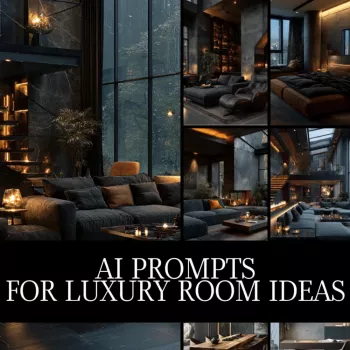
- Guidance for generating luxury room concepts with Midjourney and ChatGPT.
- Room-by-room idea frameworks (living room, bedroom, kitchen, bath, office, lounge, dining) to avoid generic results.
- Luxury finish direction: marble families, wood tones, metal pairings, fabric textures, and lighting moods.
- Usable for both remodel planning and new-build concept development.
Best-fit use cases
| Goal | How the guide helps | Outcome |
|---|---|---|
| Explore styles fast | Multiple concept directions with consistent constraints | Clear favorite design direction |
| Refine finishes | Material and palette variations without changing layout | Confident finish schedule |
| Improve presentation | More polished visuals and cohesive room narratives | Stronger client buy-in |
| Stay consistent across rooms | Repeatable style recipes for each room type | Whole-home cohesion |
If you want a ready-to-use framework, see the Luxury Room Concept Guide (Digital Download).
Luxury Room Recipes to Try (Without Overdecorating)
These “recipes” work best when you commit to a small set of dominant materials and let lighting and proportion do the heavy lifting.
- Quiet luxury: warm neutrals, tactile plaster, honed stone, low-sheen wood, minimal contrast, tailored upholstery.
- Modern penthouse: dramatic glazing, high-contrast palette, sculptural lighting, statement stone slab walls.
- Resort contemporary: natural oak, linen textures, soft curves, indoor-outdoor continuity, layered lantern-like lighting.
- Classic European: panel molding, antique brass, marble mosaic accents, curated art, symmetrical composition.
- Boutique hotel suite: plush headboard wall, integrated bedside lighting, mixed metals, high-end drapery fullness.
For a kid-friendly room that still looks intentional, a single “character” object can help organize the styling around it, like the Smart AI Robot Companion & Alarm Clock for Kids—paired with quieter millwork, warm whites, and a softer textile mix.
Getting Better Results: Inputs That Matter Most
Luxury concepts improve dramatically when the inputs are precise. Think like a spec sheet, not a vibe.
- Room constraints: dimensions, ceiling height, window size, and primary function (entertaining, family use, work).
- Lighting description: time of day, color temperature, daylight direction, and the presence of accent lighting.
- Material specificity: name surfaces and finishes (honed travertine, rift-sawn white oak, microcement, bouclé).
- Composition choices: wide-angle vs. eye-level, symmetrical vs. asymmetrical, styled vs. minimal.
- Practicality: storage, traffic paths, kid/pet durability, and maintenance requirements.
When working with Midjourney specifically, it helps to understand how parameters and image references affect outputs; the Midjourney Documentation is a reliable reference for fine-tuning.
From Concept to Real Room: Turning AI Concepts Into Purchasable Decisions
A concept becomes “real” when it turns into a repeatable decision system: finishes, lighting types, silhouettes, and a plan that respects scale.
For outdoor “lounge” concepts—poolside, patio, or event-ready—defining shade, enclosure, and lighting early can prevent expensive last-minute compromises. A practical add-on for real-world use is the Living Room Outdoor Family Shelter Tent, which can support a more finished, hospitality-style setup when paired with lantern lighting and durable textiles.
FAQ
Does this work for both renovations and new builds?
Yes. It supports early concept exploration for new builds and helps iterate layouts and finishes for remodels by starting from your room constraints and the style direction you want to validate.
Which tools can be used with the guide?
It’s built to work with Midjourney and ChatGPT, and the same frameworks can be adapted to similar image and text generation tools if you prefer another platform.
How can the ideas stay consistent across multiple rooms?
Reuse the same style recipe across rooms: repeat the palette, core materials, lighting mood, and signature details like metal finish, wood tone, and trim language to keep the whole home cohesive.














Leave a comment